
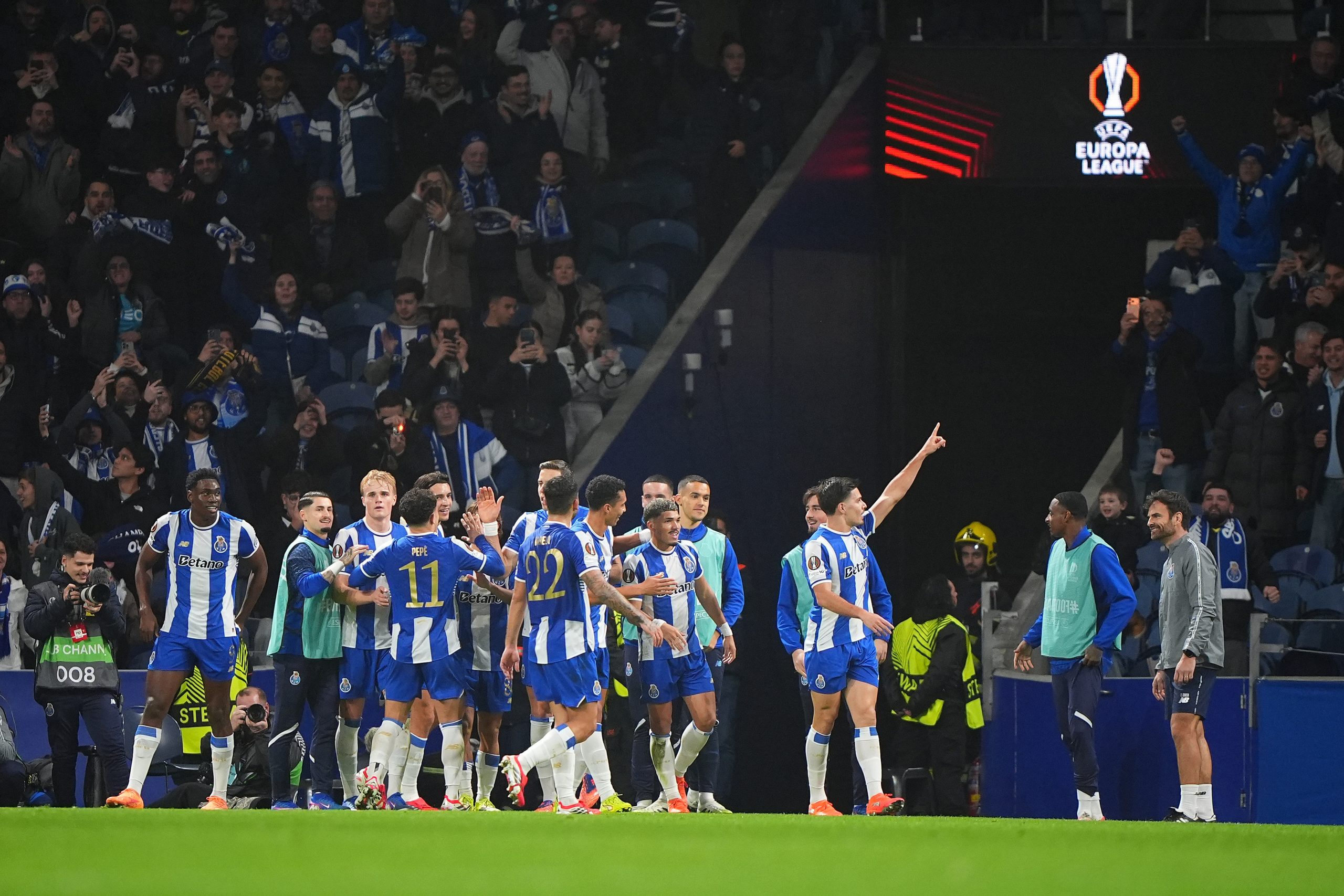
Tonight, VfB will face FC Porto in the first of two Europa League round-of-16 matches. To learn more about the club and the team from the Portuguese port city, we spoke with FC Porto expert Marcos.
With the Red Stripe: Hello Marcos and thank you for taking your time to answer my questions. FC Porto is sitting at the top of the Primeira Liga and could win the title for the first time in four years. How do rate the chances on winning the league and what is Porto doing differently this season than in the last three years?
Marcos: There’s a cliché in football, especially when you’re competing in many competitions: to go game by game without thinking too far ahead. FC Porto is currently in very good physical condition. As Farioli said in a press conference, the team has shown strong physical performance indicators in training. The first half against Benfica was very encouraging despite the result. Even though it ended in a draw, the football played by the blue-and-white team pleased all football fans. Strong in every phase of the game, Farioli’s team is prepared to face this knockout round despite its difficulty.
In my opinion, seasons are not really comparable, neither at FC Porto nor at any other club. It depends on the squad quality, the coach, and whether the signings/squad were built according to the coach’s game model.
Specifically at FC Porto, the last three seasons have been marked by a change in leadership after 40 years, with a new president, André Villas-Boas, who won the Europa League in 2011 with FC Porto.
In the Europa League, Porto finished fifth and advanced directly in to round of 16. Should they have finished higher in the league phase or is this where you see the team in terms of strength in the competition?
Because of Farioli’s squad management, finishing in the top eight places was the team’s main objective. FC Porto aims to win every competition, so they sometimes manage their squad in less difficult matches. However, Farioli’s management is a bit different because he rotates players a lot, meaning many of them end up being regular starters in a sense. Often there is one starting eleven in the Europa League and another with 6–7 changes for the league.
In the Taca de Portugal, Porto lost the first leg of the semi final at Sporting. How are the club’s chances on winning the cup — or the Europa League?
At home, FC Porto is usually very strong. In the first leg of the cup, away at Sporting, Farioli rotated six players, with Froholdt leading the changes, precisely to keep full energy for the league match against Benfica at the Luz.
The second leg will take place at the end of April, and a lot can change by then—players may get injured, Porto may secure a certain position in the league, and that can influence the teams’ mentality.
What was the reaction at Porto when it was clear they were playing Stuttgart? What kind of standing, if any, does Stuttgart have in Portugal?
To be honest, we didn’t want to face Stuttgart. In general we know the Bundesliga is a very high-intensity league with excellent physical levels, tactically well-prepared teams, and lots of individual talent. Speaking more specifically about Stuttgart, we know they are having an excellent Bundesliga season and will certainly be a very difficult team to beat. It will be an interesting matchup in many aspects. I hope I have time to analyze the opponent as I usually do (although with the course I haven’t had as much time).
Looking at the stats: Porto conceded only 10 goals in 25 games, goalkeeper Diogo Costa has already 16 clean sheets. Are the strikes in the league just not very good or is Porto very good defensively?
Even though there is a level difference between the top four teams and the rest, teams in Portugal are very well coached despite the low budgets of most clubs. FC Porto is a highly competitive and physical team, committed in every phase of the game. The secret to conceding so few goals is that, besides having a Polish defensive “wall” that provides great security (Bednarek and Kiwior) and a world-class goalkeeper (Diogo Costa), our team’s game model demands a lot of defensive work from all 11 players. It starts right from the front three, who press intensely and have many defensive tasks, whether pressing high or defending compactly in a medium-low block.
In my opinion, this is the secret behind FC Porto’s defensive success.
How would you compare the Primeira Liga to the Bundesliga in terms of strength?
Many people underestimate the Primeira Liga, but the truth is that many players move to the Premier League and succeed (some more than others). In general, the scouting level is extremely high, the analysis level is among the best, and everyone in the world recognizes the quality of Portuguese coaches, from youth development to the highest level. What mainly differentiates the two leagues is the financial management capacity of German clubs—it’s so much greater that they have far more money to invest and generate for each club, not to mention the football culture where almost all stadiums are full. In Portugal, people usually support only five clubs—FC Porto, SC Braga, Vitória SC, Sporting CP, and Benfica—and that reduces the appeal of many league matches when stadiums aren’t full. With your financial structure, we could certainly go much further.
Samu who has scored 13 goals in 20 league games, is out due to a cruciate ligament tear — how much is this hurting the team and who else should we look out for?
As I said before, FC Porto is a very balanced team in all phases of the game: strong in offensive transitions, strong in manipulating the game to create inside combinations, especially when pressed high, and frequently applying the “third-man” principle to find Varela.
Apart from the obvious defensive strength: What are the strengths and weaknesses of this Porto team?
They manipulate the center-backs with support movements from Denis, attracting the defenders and then exploiting space with a breaking run from one of the interior midfielders. They are also very competent at set pieces, having scored many goals from them this season. Their kick-offs can also be impactful, whether short or long. The weakest point is undoubtedly decision-making, most of the time in the final third.
Stuttgart has never played against Porto. What should traveling VfB supporters see or do in the city next week, can you recommend something?
I can say that you should try francesinha, bifana, and if you like fish, a good bacalhau dish. Drink plenty of Super Bock, and if you treat everyone with respect, you will certainly be treated well too. Visiting the Ribeira and Livraria Lello is also a must. The atmosphere will be incredible—I think the tickets will already be sold out.
Who, apart from Samu, will be missing the game on Thursday?
Samu, Luuk de Jong, and Nehuén Pérez.
Thank you very much!
Picture: © Jose Manuel Alvarez Rey/Getty Images